
Although, I started proper education in St. Mary's Secondary School, I would rather blog about St. Thomas' School history.
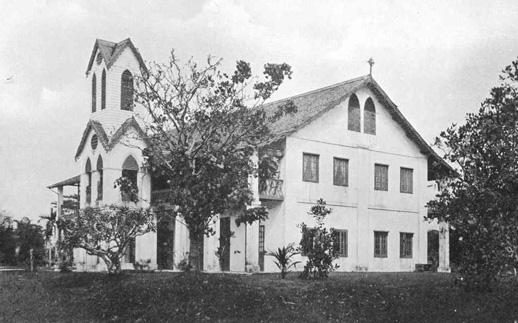
In 1847, the Anglican Mission arranged to come to Sarawak when Sir James Brooke introduced education to the State. The adult school started by Rev William Bolham Wright; conducted in the dispensary of the priest cum doctor Francis Thomas MacDougall, it had six students.
By August 5th 1848, MacDougall rented an empty house in the bazaar for his first boy's school, at that time starting with 9 boys. This home school which was to evolve into the St Thomas of today was run entirely on mission funds, but tremendous assistance from the Rajah was evident. By granting land (College Hill) to the mission, he made building of Mission House possible. In 1850, St. Thomas had 20 students. Five years later, then an increase on 5 students joined the school.
In February 1857, the school was caught in the Chinese revolt. Although the boarders were smuggled out of town and kept safe, some of the students were caught and killed by rebels. Some of the school's equipment was destroyed.
However in 1863, 43 pupils attended St. Thomas School. While by 1876, there were about 62 pupils receiving education from St. Thomas'. The school was threatened by an epidemic of cholera in the State in the year 1877, which claimed the life of the head monitor of the school, Sidukal. Then the students were evacuated to Santubong.
By 1885, the earliest building of St Thomas was built at a cost of $6,500/-. And the architect was Mr H Averett. The completed school building (in 1886) was declared open by Rajah Charles Brooke and blessed by Bishop Hose. The first stage of the main building had three classrooms on the ground floor. The dormitories and master's quarters were on the upper floor of the building. It was made possible mainly from donations by Bishop Chambers and Rajah Charles Brooke.
By the year 1909, St. Thomas had 252 pupils and out of 72 of them were boarders. Under Bishop Mounsey, a new wing including a second tower was added to the school block in the year 1913, which remains until today. The dining hall was built and opened in 1916. While in the year 1919, there was record of 7 standards.
In 1927, the assembly hall connected to the main building was completed. It has a hall on the ground floor and two classrooms above and was made possible by funds from the Mission ($6,000/-) and $8,000 was a gift from the Rajah. Two years later, two large buildings containing the four boarding houses were built again from money given by the Rajah. It was declared open by Justice Boyd. The main domitories, sick room and chapel in the old building were turned into classrooms. The top dormitories became stores. The P'Chient Hall became the new chapel and the kitchen became the vestry.
The junior certificate was conducted for the first time in 1930. The senior certificate was first held five years later.
It gets interesting here... The year 1941. In December, the school was taken over as an army camp during Japanese occupation, with the Principal's house turned into its headquaters. At the end of the war after 5 years, as a result of allied bombing and stripping of badly needed timber, the boarding houses, Principal's houses and offices were left in ruin.
However in 1952, a new tuckshop was built. The next year, the Higher School Certificate was sat for the first time. The same year on May 29th, the new science block was declared opened by the Governor of Sarawak, Sir Anthony Abell. And on the same day, school uniforms became compulsory. As the school grew bigger, the difficulty of maintaining adequate funds for the running of the school became more acute. After lengthy process of assessment and careful consideration, St Thomas School became an aided school, with 50% of approved capital expenditure being undertaken by the government.
In 1957, common entrance examination was introudced, where 30% of the students from primary school was selected for secondary school. November that year, the contruction of the new primary school building started.
In June 1958, the newly completed primary school building was declared open by Datuk Wee Kheng Chiang, who donated $50,000/-, along with the government contribution of 50% of the construction cost.
A new assembly hall was completed in 1969, named after the main donor, Datuk James Wong (who donated $80,000/-). The other major donor was Datuk Wee Hood Teck. The ground floor of the new assembly hall had four classrooms, a library and toilets. Yet, the building was declared opened by TYT Yang Di Pertua Negeri Sarawak, Tan Sri Tuanku Haji Bujang.
January 4th 1972, the junior secondary school moved in to the newly completed block, with toilets, bicycle shed and driveway. The next year, the 125th anniversary of the founding of the First Anglican Schools in Kuching was celebrated.
However, the late Tun Hussein Onn, then Education Minister, officially declared open the new Junior secondary school on March 12th 1973. In May that same year, Mr Song Thian Eng, one of the most faithful, longest serving and the most famous student and staff of the School retired as Headmaster. He was awarded ABS by the governent for his contribution to education.
The common entrance examination was abolished, leading to automatic promotion to Form One in line with the government's comprehensive education system. Primary 5 assessment test was introduced in 1974. Two years later, the Local Junior Examination was replaced by L.C.E. While in 1979 the Senior Cambrige Examination was replaced by M.C.E.
An unfortunate even happened on October 5th 1979 when the main school building was burned down, leaving an empty shell apart from the two towers that defied burning. The school library which occupied the first floor, scouts' den at the attic and the roof, along with lecture hall, audio visual room and other classrooms on the ground floor were consumed. Under the chairmanship of the late Tan Sri Ong Kee Hui, a fund raising committee comprising most of the high ranking officers and politicians in the state set out to raise the necessary fund to restore the main block.
In 14 May 1989, the principal's office and staff room was burned, though little was lost, much records was consumed.
Enough of the history until the late 80s :) Now, moving on to something else...

The advent of our new badge (replacing the old), which was entirely designed and executed by the late Mr. Kong Yu Siung (P.B.S., A.M.N.), one of our masters, marks yet another turning point in the history of our school.
The design on the badge consists of a mitre, a lamp, a carpenter's square and a badger, the whole shield being surrounded by a girdle with the motto beneath.
The mitre indicates the fact that the school is a Christian one under the Church with the Bishop as its head, the mitre being the distinctive headdress of a Bishop.
The lighted lamp symbolized the light of knowledge that we gather in the school.
The carpenter's square is the emblem of St. Thomas, our Patron Saint, who was a carpenter.
The animal as will be recognized by all is the Badger, which is to be found on the crest of The Sarawak Government. It is with permission of the Government that we have been allowed to include this in our design as indicating the country in which the school works.
The badge takes the shape of a shield. Just as the knights of old wore their shields as sources of inspiration and protection, we hope that by wearing our badges we may be constantly reminded to overcome many temptations and ungentlemanly acts in our battle of life.
The idea of the girdle of Our Lady surrounding the whole shield has been taken from tradition which says that she threw it to St. Thomas from heaven. It is very appropriate that the relationship between the two schools - St. Thomas' and St. Mary's - which stand in the same Mission compound, should thus be connected.
The Motto, "Aim Higher", is one which is applicable to all walks of life. It was adopted by the school since 1942 by the suggestion of Fr. Hollis at a School Prize-Giving."
I think I will write more later. I need new pictures of the school now and I want to dig up the history of the school song :)
